18.04.2020

Generate Jwt Token With Key

Oct 27, 2019 Token signed with key A - Token verified with key B (RSA scenario) Now if the attacker changes the alg to HMAC, she might be able to create valid tokens by signing the forged tokens with the RSA. Here you can see with some basic inputs, you can create real JWTs. We used Sha256 to digitally sign signature. Anyone can decode a token but no one can man in the middle replace data with a valid signed signature (yet anyways). New developers need to know that for security reasons (guard your private keys!). Everything Together.

  1. Postman Generate Jwt Token
  2. Generate Jwt Token With Private Key
  3. Jwt Token Stream Elements
  4. Jwt Generate Token With Public Key
  5. Generate Jwt Token With Private Key C#

Java support for JWT (JSON Web Tokens) used to require a lot of work: extensive customization, hours lost resolving dependencies, and pages of code just to assemble a simple JWT. Not anymore!

Generate a JSON Web Token (JWT)/RSA Token by following these steps: 1. From Terminal, run the following 2 commands to create an RSA key pair (Figure 1): openssl genrsa -out mykey.pem 4096 open. Expiration Control: API keys usually don't expire unless you revoke them. JSON Web Tokens can (and often do) have an expiration. Devices: You can't put an API key that has full access on a device, because what is on a phone or tablet can easily be stolen. But you can put a JWT with the right set of permissions. You create the token, signing it with the private key you downloaded from App Store Connect. To generate a signed JWT: Create the JWT header. Create the JWT payload. Jan 29, 2020  In the following scenario, we will generate a JWT token and then validate it. Everything will be done using API calls, so Keycloak’s UI is not exposed to the public directly. Set up a user. First, we will create a simple user in Keycloak, as shown in Figure 1.

This tutorial will show you how to use an existing JWT library to do two things:

  1. Generate a JWT
  2. Decode and verify a JWT

You’ll notice the tutorial is pretty short. That’s because it’s that easy. If you’d like to dig deeper, take a look at the JWT Spec or dive into this longer post about using JWTs for token authentication in Spring Boot apps.

What are JWTs?

JSON Web Tokens are JSON objects used to send information between parties in a compact and secure manner. The JSON spec, or Javascript Object Notation, defines a way of creating plain text objects using key value pairs. It’s a compact way of structuring data built upon primitive types (numbers, strings, etc…). You’re probably already pretty familiar with JSON. It’s like XML without all the brackets.

Tokens can be used to send arbitrary state between parties. Often here “parties” means a client web application and a server. JWTs have many uses: authentication mechanism, url-safe encoding, securely sharing private data, interoperability, data expiration, etc.

In practice, this information is often about two things: authorization and session state. JWTs can be used by a server to tell the client app what actions the user is allowed to execute (or what data they are allowed to access).

JWTs are often also used to store state-dependent user data for a web session. Because the JWT is passed back and forth between the client app and the server, it means that state data does not have to be stored in a database somewhere (and subsequently retrieved on every request); because of this, it scales well.

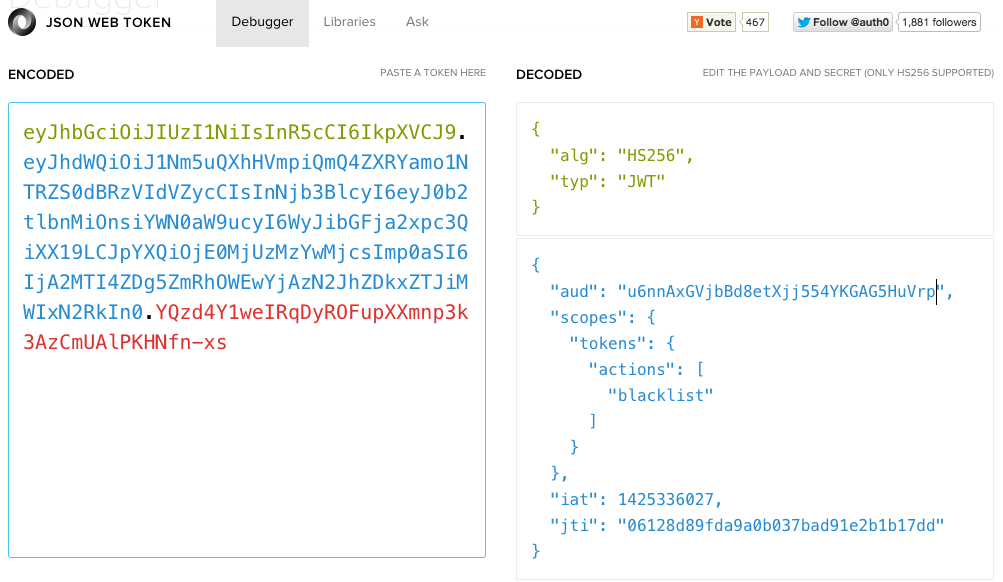
Let’s take a look at an example JWT (taken from jsonwebtoken.io)

JWTs have three parts: a header, a body, and a signature. The header contains info on how the JWT is encoded. The body is the meat of the token (where the claims live). The signature provides the security.

There’s a lot of detail we’re not going to go into here regarding how tokens are encoded and how information is stored in the body. Check out the previously mentioned tutorial if you want.

Don’t forget: cryptographic signatures do not provide confidentiality; they are simply a way of detecting tampering with a JWT, and unless a JWT is specifically encrypted, they are publicly visible. The signature simply provides a secure way of verifying the contents.

Great. Got it? Now you need to make a token with JJWT!For this tutorial, we’re using an existing JWT library. Java JWT (a.k.a., JJWT) was created by Les Hazlewood (lead committer to Apache Shiro, former co-founder and CTO at Stormpath, and currently Okta’s very own Senior Architect), JJWT is a Java library that simplifies JWT creation and verification. It is based exclusively on the JWT, JWS, JWE, JWK and JWA RFC specifications and open source under the terms of the Apache 2.0 License. The library also adds some nice features to the spec, such as JWT compression and claims enforcement.

Generate a Token in Java

This parts super easy. Let’s look at some code. Clone the GitHub repo:

This example is pretty basic, and contains a src/main/java/JWTDemo.java class file with two static methods: createJWT() and decodeJWT(). Cunningly enough, these two methods create a JWT and decode a JWT. Take a look at the first method below.

Crypto key generate rsa mod 1024. First, you must create the keys on both devices. We recommend using at least 1024-bit keys in production networks: Router1#configure terminal Enter configuration commands, one per line. End with CNTL/Z. Router1(config)#crypto key generate rsa The name for the keys will be: Router1.oreilly.com Choose the size of the key modulus in the range of 360 to 2048 for your. We need configure SSH on a Cisco router or switch in order to access it remotely, unless we’re using an access server. The label is important, I'll tell you! In a minute why C1801(config)# crypto key generate rsa modulus 1024 label C1801 The name for the keys will be: C1801% The key modulus size is 1024 bits% Generating 1024 bit. Crypto key generate rsa general-keys label tokenkey1 storage usbtoken0: The following example specifies the redundancy keyword: Router(config)# crypto key generate rsa label MYKEYS redundancy. The name for the keys will be: MYKEYS Choose the size of the key modulus in the range of 360 to 2048 for your General Purpose Keys. Feb 17, 2018  crypto key generate rsa general-keys label tokenkey1 storage usbtoken0: The following example specifies the redundancy keyword: Router(config)# crypto key generate rsa label MYKEYS redundancy. The name for the keys will be: MYKEYS. Choose the size of the key modulus in the range of 360 to 2048 for your. General Purpose Keys. Oct 02, 2015  SSH Config and crypto key generate RSA command. Use this command to generate RSA key pairs for your Cisco device (such as a router). Keys are generated in pairs–one public RSA key and one private RSA key. If your router already has RSA keys when you issue this command, you will be warned and prompted to replace the existing keys with new keys.

To summarize, the createJWT() method does the following:

  • Sets the hashing algorithm
  • Gets the current date for the Issued At claim
  • Uses the SECRET_KEY static property to generate the signing key
  • Uses the fluent API to add the claims and sign the JWT
  • Sets the expiration date
Jwt

This could be customized to your needs. If, for example, you wanted to add different or custom claims.

Decode a Token

Now take a look at the even simpler decodeJWT() method.

The method again uses the static SECRET_KEY property to generate the signing key, and uses that to verify that the JWT has not been tampered with. The method will throw io.jsonwebtoken.SignatureException exception if the signature does not match the token. If the signature does match, the method returns the claims as a Claims object.

That’s pretty much it!

Run the JUnit Tests

For extra credit, you can run the JUnit tests in the example project. There are three tests, and they demonstrate some basic features on the JJWT library. The first test shows the happy path, creating and successfully decoding a valid JWT. The second test shows how the JJWT library will fail when you attempt to decode a totally bogus string as a JWT. The last test shows how a tampered-with JJWT will cause the decodeJWT() method to throw a SignatureException.

You can run these tests from the command line using:

The -i is to set Gradle’s log level to Info so that we see the simple logging output from the tests.

Learn More About Working with JWTs in Your Java Apps

The JJWT library makes it super easy to create and verify JWTs. Just specify a secret key and some claims, and you’ve got a JJWT. Later, use the same secret key to decode the JJWT and verify its contents.

Creating and using JJWTs is now so easy, why aren’t you using them?

Don’t forget SSL! Remember that unless JWTs are encrypted, the information encoded within them is generally only Base64 encoded, which any small child and some pets can read. So unless you want China, Russia, and the FBI reading all of your session data, encrypt it using SSL.

Baeldung has a pretty good in depth tutorial on Java and JWTs.

Also, here are some more links from the Okta blog to keep you going:

Postman Generate Jwt Token

If you have any questions about this post, please add a comment below. For more awesome content, follow @oktadev on Twitter, like us on Facebook, or subscribe to our YouTube channel.

Please enable JavaScript to view the comments powered by Disqus.
4 Sep 2017CPOL
Learn how to create JWT and use with WebApi, REST and MVC all build with .Net Core

Intro

JWT (JSON Web Token) becomes more and more popular as a standard for securing web sites, and REST services. I discuss how you can implement JWT security for both a REST service and a MVC web application all build with .Net Core. I divided the JWT security in 3 blogs

  1. Create JWT
  2. Secure REST service with JWT
  3. Secure web application with JWT

This is the first of the three blogs and I start with a small JWT explanation.

JWT Primer

JWT (JSON Web Tokens) is open, security protocol for securely exchanging claims between 2 parties. A server generates or issues a token and is signed by a secret key. The client also knows the secret key and the key and can verify if the token is genuine. The token contains claims for authentication and authorization. Authentication is simply the verification if someone is really who he claims to be be. Authorization is when an user is granted to access a resource or execute a certain task. For example user A can view payments and user B can execute payments. JWT are self contained. Because JWT is a protocol and not a framework it works across different languages like .net , Java Python and many more. The JWT is usually transmitted by adding the JWT to the header of the request but can also be used as a parameter in an URL. This transmission makes the JWT stateless.

JWT Structure

JWT has three parts:

  1. Header
  2. Payload
  3. Signature

The parts are separated with a dot.

aaaa.bbbb.cccc

Header

The header and the payload has one or more key value pairs. The header contains the token type ('typ') and the hashing algorithm ('alg') SHA256.

The Header and the Payload parts are base64 encoded, this makes the Header part:

Payload

The payload part is the most interesting section because it contains all the claims. There are three claims types Registered, Public and Private claims.

Registered Claims

The registered claims are part of the JWT standard and have the same purpose on all implementations. In order to keep the JWT size small the key is always 3 characters long. Here's the short list:

  • iss Issuer Identifies who issued the JWT.
  • sub Subject Identifies the principal (read user) of the JWT.
  • aud Audience Identifies recipients the JWT is intended for.
  • exp Expiration Sets the expiration date and when expired the JWT must be refused.
  • nbf Not before. Sets the date before the JWT may not be used.
  • iat Issued at. Sets the date when the JWT was created.
  • jti Unique identifier for the JWT. Use for a one time token and prevent token replay.

All registered claims dates are in the Unix Epoch date format and describe the seconds after UTC time 1 January 1970.

Public Claims

Public claims contain more general information for example 'name'. Public names are also registered to prevent collision with other claims.

Private Claims

A private claim is agreed between issuer and audience. Always check if a private claim does not collide with existing claims. The claim 'role' is private claim example we will use later on.

Payload Example

will result in

Signature

So far there was nothing secure about a JWT. All data is base64 encoded and although not human readable it's easy to decode it into a readable text. This where the signature comes in. With the signature we can verify if the JWT is genuine and has not been tampered. The signature is calculated from the Header, the Payload and a secret key.

The secret key is symmetric and is known to issuer and client. Needless to say, be care full where you store the secret key!

Put it all together

The screen dump below is constructed with help from https://jwt.io/ where you can test and debug JWT claims. The left pane holds the JWT and the other pane shows the extracted Header and Payload. If you add the secret key the page also verifies the signature.

General JWT Security Overview

The solution overview shows three separate servers, the Web application, the RESTful service and the JWT issuer server. They could be hosted in one server and in one project but I made three items for it. In this way it's much more clear how each server is configured. Because JWT is self contained there no need for some kind of connection between the JWT issuer and the REST service to validate the JWT claim.

General JWT Flow

The basic JWT flow is quite simple:

  • The user enters the login credentials on the web application.
  • The web application send the login credentials to JWT issuer and ask for a JWT claim.
  • JWT issuer validates login credentials with user database.
  • JWT issuers creates JWT based on claims and roles from user database and add the 'exp' (Expires) claim for limited lifetime (30 minutes).
  • JWT issuer sends the JWT to web application.
  • Web application receives JWT and stores it in an authentication cookie.
  • Web application verifies JWT and parses payload for authentication and authorization.
  • Web application adds JWT to REST service calls.

Pros and cons

Pros:

  • Comparatively simple. Security is never easy, what ever you choose. JWT is a smart design and combined with the .net libraries who do the 'hard' work makes JWT relative easy to implement.
  • REST service is truly stateless as it supposed to be. In most cases security adds some kind of session management for authentication.
  • Stateless makes scalable. If you need more servers to handle the workload there is no need to shares sessions among all the servers. This makes scaling easier and less error prone.
  • Useable across different services. JWT are self contained and the service can authorize without having access to the user database.
  • JWT provides neat options for temporary authorization elevation. Claims can be added or removed during an user session. For example you can add a claim to a user that he successfully passed a two way authentication for executing a payment. The claim can be removed when the payment is successfully executed. In this manner there's no need to create special way for tracking the user status.

Cons:

  • JWT has no build in features for sliding expirations, although you can build it your self.
  • The Secret key is very important. If the secret key is somehow stolen or leaked the security is heavily compromised.

Create JWT Issuer project

The main task is to deliver JWT claims based on user credentials. The project is a standard MVC application with Individual User Accounts as Authentication.

The Individual User Accounts Authentication is used to secure the website and having easy access to users and their roles and claims. I added the package Microsoft.AspNetCore.Authentication.JwtBearer for the actual JWT creation. Because JWT is not used to secure this web site caller there is no need to register JwtBearer services during start up. Only the JWT parameters are configured during start up.

The DI (Dependency Injection) pattern is applied for the configuration. The class JwtIssuerSettings maps to the config section JwtIssuerSettings in appsettings.json and the class JwtIssuerFactory creates and instance of IJwtIssuerOptions interface.

They are added to the service collection and are now available as parameters in controller constructor.

Create JWT Claim

The function Login on controller JwtIssuerController creates the JWT claim. The process is pretty straight forward:

  • Find the user.
  • Check password.
  • Create Issuer, Subject, Email, Unique Id and IssuedAt claims.
  • Collect user roles (claims) from storage
  • Create JWT based on configuration parameters and secret key.
  • Send token to caller

Test Data

During startup an in-memory database is created. It contains three users and three roles and mimics an Human Resource department.

Roles:

  • Employee this can be any company member.
  • HR-Worker, every HR department member.
  • HR-Manager, sure it's the HR-boss.

Users:

  • employee@xyz.com
  • hrworker@xyz.com
  • hrmanager@xyz.com

Generate Jwt Token With Private Key

Namespace Microsoft.AspNetCore.Identity contains RoleManager<IdentityRole> and is ready to use without explicit configuration. You don't read much about it in examples or documentation. It's a bit of a missed chance because the class is really useful for managing the roles in the system.

Testing JWT claim

Jwt Token Stream Elements

I added Swagger by adding package Swashbuckle.AspNetCore for testing. You can read here more how to configure swagger. In short it comes to this

Swagger can now be tested at http://localhost:49842/swagger/

We can test the response at https://jwt.io/ Cinch audio recorder key generator.

and all looks fine and we can start securing the REST service.

Visual Studio Startup Projects

Sometimes the Visual Studio startup Project is lost and prevent running the application. Right click on the solution and choose 'Set Startup Projects..'

And repair the startup setting:

Conclusion

This blog demonstrates how you can setup a JWT (JSON Web Token) issuer. Stateless, self contained, scalable and other features makes JWT a smart design. With help from packages integrates JWT well with .Net Core and takes little effort to setup.

Next post : JWT Security Part 2, Secure REST service

Further reading

Jwt Generate Token With Public Key

Versions

1.0 2017-08-31 Initial release

1.1 2017-09-05 Source Code upgraded for Dot Net Core 2.0

Generate Jwt Token With Private Key C#