Generate Public Key From Pirvate Openssl
Mar 03, 2020 This page explains how to generate public/private key pairs using OpenSSL command-line tools. Device authentication. Cloud IoT Core uses public key (or asymmetric) authentication: The device uses a private key to sign a JSON Web Token (JWT). The token is passed to Cloud IoT Core as proof of the device's identity. Generating keys using OpenSSL There are two ways of getting private keys into a YubiKey: You can either generate the keys directly on the YubiKey, or generate them outside of the device, and then importing them into the YubiKey. Command Line Elliptic Curve Operations. OpenSSL provides two command line tools for working with keys suitable for Elliptic Curve (EC) algorithms: The only Elliptic Curve algorithms that OpenSSL currently supports are Elliptic Curve Diffie Hellman (ECDH) for key agreement and Elliptic Curve Digital Signature Algorithm (ECDSA) for signing/verifying.
I know that you can generate a new key pair with a command like. Openssl ecparam -genkey -name secp256k1 And the resulting output will contain a new private key with the encoded public key. Dec 01, 2015 To generate a public/private key file on a Windows system: You will need to have OpenSSL installed. Create a new directory on your C drive and give it an appropriate name (i.e., Test). Open a Command Prompt window and go to the new directory. Apr 12, 2020 Now we will use the private key with openssl to create certificate authority certificate ca.cert.pem. OpenSSL uses the information you specify to compile a X.509 certificate using the information prompted to the user, the public key that is extracted from the specified private key which is also used to generate the signature.
Download and install the OpenSSL runtimes. If you are running Windows, grab the Cygwin package.
OpenSSL can generate several kinds of public/private keypairs.RSA is the most common kind of keypair generation.[1]
Other popular ways of generating RSA public key / private key pairs include PuTTYgen and ssh-keygen.[2][3]
Generate an RSA keypair with a 2048 bit private key[edit]
Execute command: 'openssl genpkey -algorithm RSA -out private_key.pem -pkeyopt rsa_keygen_bits:2048'[4] (previously “openssl genrsa -out private_key.pem 2048”)
e.g.
Make sure to prevent other users from reading your key by executing chmod go-r private_key.pem afterward.
Extracting the public key from an RSA keypair[edit]
Execute command: 'openssl rsa -pubout -in private_key.pem -out public_key.pem'
e.g.
A new file is created, public_key.pem, with the public key.
It is relatively easy to do some cryptographic calculations to calculate the public key from the prime1 and prime2 values in the public key file.However, OpenSSL has already pre-calculated the public key and stored it in the private key file.So this command doesn't actually do any cryptographic calculation -- it merely copies the public key bytes out of the file and writes the Base64 PEM encoded version of those bytes into the output public key file.[5]
Viewing the key elements[edit]
Execute command: 'openssl rsa -text -in private_key.pem'
All parts of private_key.pem are printed to the screen. This includes the modulus (also referred to as public key and n), public exponent (also referred to as e and exponent; default value is 0x010001), private exponent, and primes used to create keys (prime1, also called p, and prime2, also called q), a few other variables used to perform RSA operations faster, and the Base64 PEM encoded version of all that data.[6](The Base64 PEM encoded version of all that data is identical to the private_key.pem file).
Password-less login[edit]
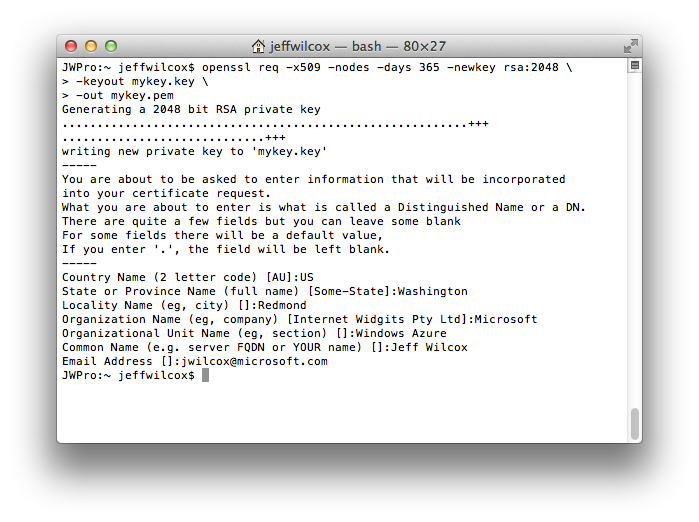
Often a person will set up an automated backup process that periodically backs up all the content on one 'working' computer onto some other 'backup' computer.
Because that person wants this process to run every night, even if no human is anywhere near either one of these computers, using a 'password-protected' private key won't work -- that person wants the backup to proceed right away, not wait until some human walks by and types in the password to unlock the private key.Many of these people generate 'a private key with no password'.[7]Some of these people, instead, generate a private key with a password,and then somehow type in that password to 'unlock' the private key every time the server reboots so that automated toolscan make use of the password-protected keys.[8][3]
Further reading[edit]
- ↑Key Generation
- ↑Michael Stahnke.'Pro OpenSSH'.p. 247.
- ↑ ab'SourceForge.net Documentation: SSH Key Overview'
- ↑'genpkey(1) - Linux man page'
- ↑'Public – Private key encryption using OpenSSL'
- ↑'OpenSSL 1024 bit RSA Private Key Breakdown'
- ↑'DreamHost: Personal Backup'.
- ↑Troy Johnson.'Using Rsync and SSH: Keys, Validating, and Automation'.
- Internet_Technologies/SSH describes how to use 'ssh-keygen' and 'ssh-copy-id' on your local machine so you can quickly and securely ssh from your local machine to a remote host.
Generate Key With Openssl
This guide will show you how to convert a .pfx certificate file into its separate public certificate and private key files. This can be useful if you want to export a certificate (in the pfx format) from a Windows server, and load it into Apache or Nginx for example, which requires a separate public certificate and private key file.
In the examples below, the following files will be used:
domain.name.pfx – This will be the PFX file containing the public certificate and private key.
domain.name.crt – This is the public certificate file outputted by OpenSSL.
domain.name.key – This is the private encryption key for the above certificate outputted by OpenSSL.
Extracting the public certificate from the pfx file
Enter in the password for the PFX file when asked. You cant export the certificate or key if you don’t have this password.
You will now have the public certificate file (eg: domain.name.crt).
Extracting the private key from the pfx file
This provides a way to document ETL process and used in understanding the given job.2. Debug and Development stages. Useful for development and testing. Row generator replicates a set of data which sticks to the appropriate metadata (cycled or randomized). Surrogate key generation in datastage parallel job 2016. Column generator can add one or more column to the flow and can generate test data for the column.
Enter in the password for the PFX file when asked. You cant export the certificate or key if you don’t have this password.
You will now have the private key file (eg: domain.name.key).